


Your shopping cart is empty!
Melon "De Luneville"
Eco seeds
New
Melon "De Lunéville".
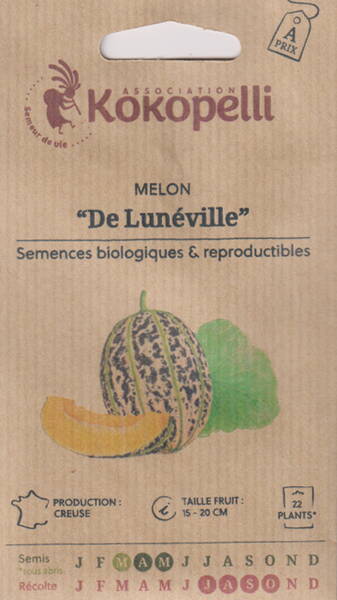
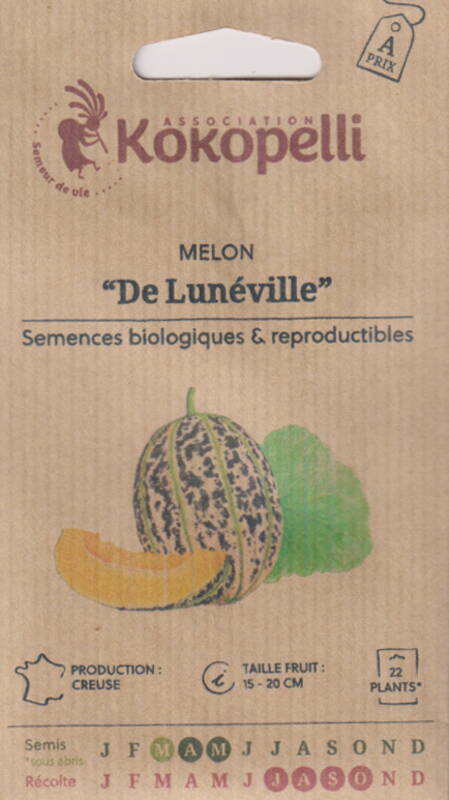
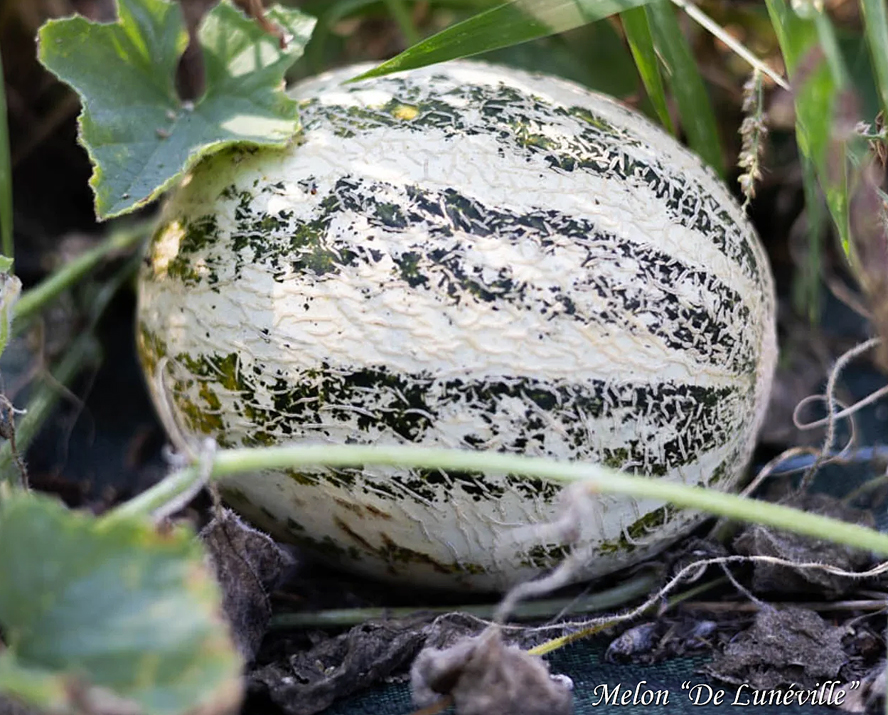
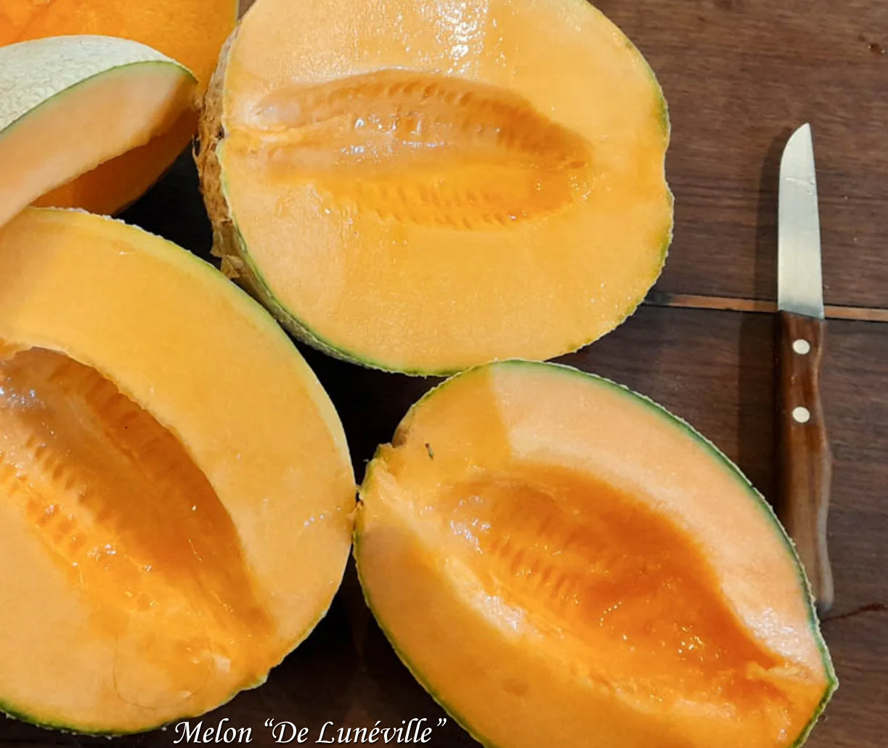
This heirloom variety from Lorraine, which possesses high resistance to cold and dampness, produces pale green fruits with dark green ribs, round or oval in shape, weighing between 1.5 and 2.5 kg. Its orange flesh is juicy and melting, with a delightfully sweet taste.
Ripening speed: early-ripening.
Fruit size: 15–20 cm.
Shape: round.
Texture: firm.
Growth habit: vining.
History: this unique heirloom variety originates from the historic region of Lorraine, France. It was once grown on a very large scale. It is a successful cross between the «Noir des Carmes» and «Prescott» varieties. It was carefully preserved and cultivated for 30 years by Michel Ongaretti, president of the Lunéville Horticultural Society.
This heirloom variety from Lorraine, which possesses high resistance to cold and dampness, produces pale green fruits with dark green ribs, round or oval in shape, weighing between 1.5 and 2.5 kg. Its orange flesh is juicy and melting, with a delightfully sweet taste.
Ripening speed: early-ripening.
Fruit size: 15–20 cm.
Shape: round.
Texture: firm.
Growth habit: vining.
History: this unique heirloom variety originates from the historic region of Lorraine, France. It was once grown on a very large scale. It is a successful cross between the «Noir des Carmes» and «Prescott» varieties. It was carefully preserved and cultivated for 30 years by Michel Ongaretti, president of the Lunéville Horticultural Society.
* The melon is a very ancient crop. Its ancestors are believed to be perennial forest vines from the Tertiary and even Cretaceous periods. Ancient people considered it a heavenly fruit that miraculously fell to earth. Its images are found on ancient Egyptian tombs and the famous frescoes of the Vatican. The melon was well known in Europe even in ancient times. It was so popular and desired that people even died from eating too much of it. History tells us that a «melon» death overtook four emperors and Pope Paul II. It appeared in Russia in the 12th century. Under Tsar Alexei Mikhailovich, it was successfully grown in the Kremlin gardens. The famous Russian vegetable breeder Yefim Grachev also grew melons near the harsh climate of St. Petersburg.
Growing seedlings.
In the Urals and other regions with a cool climate (like the Baltics and Scandinavia), melons are grown using seedlings in a greenhouse (glass or film). In the open ground, only extra-early varieties should be grown. The plumpest seeds are selected for sowing. Melon seeds are prepared for sowing in the same way as seeds of other plants of the Cucurbitaceae family (treated in a 1% solution of potassium permanganate for 30 minutes). After that, it is useful to soak them in a solution of fertilizers or microelements, and treat them with Trichodermin to reliably prevent root rot.
Melon seedlings are grown for 28-30 days. They are usually planted in the greenhouse on May 10-15 (when the threat of frost has passed). Seedlings are grown in individual pots or bags, as they do not tolerate transplanting well. Pots for melon seedlings should be the same size as for cucumbers: 8-10 cm in diameter, 10 cm high. Seedlings can be grown directly in a heated greenhouse or indoors on a bright windowsill.
The soil for seedlings should be loose, fertile, and permeable to air and water.
You can use the following nutrient mixture: 1 part garden soil, 1 part peat, 0.5 parts sand, 1 part rotted manure (can be omitted), 1 part old fine straw. For 10 kg of such a mixture, add 1 cup of wood ash, 0.5 cups of lime, 1 teaspoon of potassium sulfate, and 1 tablespoon of superphosphate. The soil is mixed thoroughly, pots are filled, watered well, and 1-2 seeds are sown in each. When the shoots appear, the weaker sprout is carefully removed. Only one strong plant remains in the pot. Until germination, the temperature is maintained at +20...+25°C during the day, and +15...+18°C at night. After the shoots appear, it is reduced for 3-4 days (down to 17-18°C during the day) so that the seedlings do not stretch, and then raised again to +25°C. Seedlings are watered only with warm water, very moderately and infrequently. To protect the root collar from the treacherous «blackleg» disease, the soil in the pot is sprinkled with a 1-2 cm layer of dry, calcined sand. Seedlings are fed if necessary. The first time - at the stage of one true leaf with a mullein solution (1:10) adding 1 tablespoon of superphosphate per bucket of solution. Then, before planting in the ground: 10 g of ammonium nitrate, 5 g of superphosphate, 5 g of potassium sulfate per 1 bucket of water. By the time of planting, the seedlings should have 3-4 true leaves, be strong, stocky, with a perfectly developed root system...
* Pickled (Marinated) Melon.
Cut the flesh of a medium-ripe (not overripe!) melon into neat cubes. Pack the prepared melon tightly into small sterilized jars, pour cold marinade over it, cover with parchment paper and tie (or cover with lids). Place the jars in a deep pot, put a thick cloth or heavy paper on the bottom (under the jars), pour water into the pot up to the shoulders of the jars, and pasteurize at a gentle simmer for 15-20 minutes. Removing the pot from the heat, leave the jars in it until completely cooled. Then remove from the water, seal hermetically, and store in a cold place.
To prepare the zesty marinade: 1 cup of vinegar (preferably apple cider), 1 cup of water, 1 cup of sugar, 2 tbsp of natural honey, 2-3 cloves, a piece of cinnamon, a little allspice, and 0.5 tsp of salt. Boil all this in an enamel pot, cool, and strain. The exquisite pickled melon is served as an original salad accompanying roast meat and poultry.